God works in mysterious ways, and honestly I wish I could brag that my conversion was like St Paul on the road to Damascus. Instead, mine was much quieter and worked over many years of my childhood, teenage years and eventual young adult time.
Growing up Baptist
I grew up like a lot of kids in the southern US, born into a Baptist type tradition. I learned that God existed, he loved us and sent his son to die for us, and one of the largest things was the Bible was all that we needed to have a relationship with Jesus Christ. Though I went to public school and knew a lot of kids who went to church, I did not attend the big First Baptist Church that had all the kid programs. My dad always tried to take the more traditional and humbler route by taking us to the smallest church, with the youngest adult at the time being my father who was probably in his early 50s at the time.
I was lucky and did not have religious trauma that led to me finding a different church later in life, in fact, my experience was overwhelmingly positive. This was certainly the church that evangelized me through love and baptized me. All the old ladies loved me because I reminded them of their youngest grandson and it would definitely be a sin if I did not mention the southern potlucks!
Now it’s time to turn to the confusion of Baptist theology. This is not meant to be ill-natured because the Baptist tradition was very loving to me. If I remember correctly, I was baptized around the 3rd grade. I remember telling the preacher I desired to receive it and so we sat in the back of the church and discussed it. I remember talking to him about what I thought baptism was. I thought it was the cleansing of sin, he told me that baptism had nothing to do with salvation because I had already declared that Christ was LORD. That it was just a public declaration of my faith. This was the first discussion in theology that I can remember that seemed to contradict what I had read and even sung about in the gospel hymns. That is something I had never forgotten.
Brief summary leading up to college
I wish that I could say that I continued to attend church on a regular basis and never really stopped practicing but like most kids, the whole family seems to get busy growing up and being involved in sports, FFA, and many after-school activities. That lifestyle can get exhausting and yes, Sundays are supposed to be rest days but not from God. Unfortunately we had many years of permanent rest days…
College
By this time, I was your average college guy. I was looking for the pretty girl, playing video games and partying with my friends, and yes my grades were reflecting that hahah. College was fun and I still miss it today even though it’s been close to 10 years since I started but college was also tough for me mentally. When I was nearing the end of my senior year of high school, I had my life planned out. I was going to attend a college on the other side of the state, get my degree and become a military pilot. Well it did not go the way I planned. I got home sick, dropped out of ROTC and honestly had trouble finding purpose. What I did know is that I was not going to give up becoming a military aviator.
I hopped around to a few different community colleges and kept on track on finishing my degree. I eventually found myself at a 4-year college being one class away from moving into advanced classes but there was one class I kept putting off. That was philosophy.
Philosophy 101
Philosophy was not what I thought it was. I was under the impression that it was about writing a stupid paper on why I thought the sky was blue. I finally signed up for it and was ready to get the 16 weeks over with. The first day of class, I arrived early but not locked in, but that day something caught my mind. The professor walked into class and he was wearing a priest’s collar! That was totally unexpected. To be honest, I had heard every anti-priest rhetoric from the Baptist church but I thought let me use college as an opportunity to be open minded and to learn.
The professor was not Catholic but was an Episcopal priest. His name was Father Matt and was actually a convert from the Baptist church! He was really friendly and really cared about the curriculum and if the students did learn. It did not take long for us to jump into material. He explained very quickly that philosophy is the love of wisdom ( the study of wisdom). That it is the basis of thinking and that everything we know is ultimately rooted in it. I was blown away! I did not know it yet but this class would be life changing to me.
We talked about form and matter and other basic philosophy principles but the book that really touched not only my mind but my soul was “The Five Dialogues of Plato”. Though I barely passed the class, this book was fantastic. These five short books are all about Socrates, a wise old man in ancient Greece who loved asking deep questions. He believed that by asking questions, people could find the truth and live better lives. Each dialogue shows a different part of his story, from his conversations to his trial, jail time, and finally his death.
The dialogue that reached me was of “Euthyphro”. The question that is proposed here is “what is piety”. Here Socrates is having a dialogue with a man named Euthyphro. Euthyphro is outside of the courthouse about to go in and prosecute his own father. Socrates is about to go in and defend himself for corrupting the youth. Socrates tells Euthyphro that he must know what he is doing since he is prosecuting his own father. Euthyphro says he is doing it because it is the right thing to do. It is pious. Here Socrates and him engaged in a dialogue around The question What is piety? Ultimately Euthyphro is unable to answer the question but what stuck to me is the contradiction of polytheism. One of the answers that his friend gives is that piety is “what is pleasing to the gods”. Socrates pushes back with another question and says “how can that be so if the same action is pleasing to one god but is not pleasing to another? ”.
This showed me that God, if he existed, could not contradict himself and that God had to be singular. I do not know why but this led me to rediscovering my faith in God and that I was after objective truth. I did not want to belong to the faith of my fathers for cultural reasons but to be a part of the Church that God left us on earth. Faith had to be reasonable.
The Bible is a Catholic Book
I knew that the Bible was the infallible Word of God. That was my starting point. I decided it was time to read the Scriptures with an open heart — without bias, without inherited assumptions. I wanted to see for myself what the Bible actually said about baptism and about the Church that Christ established.
I already knew that the Bible did not come before the Church — the Church came first, and from her came the Scriptures. But I wanted to understand how that Church actually looked in the Bible itself.
I’m not a biblical scholar by any means, but it didn’t take long before I started noticing that many things in Scripture simply didn’t match what I had been taught in Baptist theology.
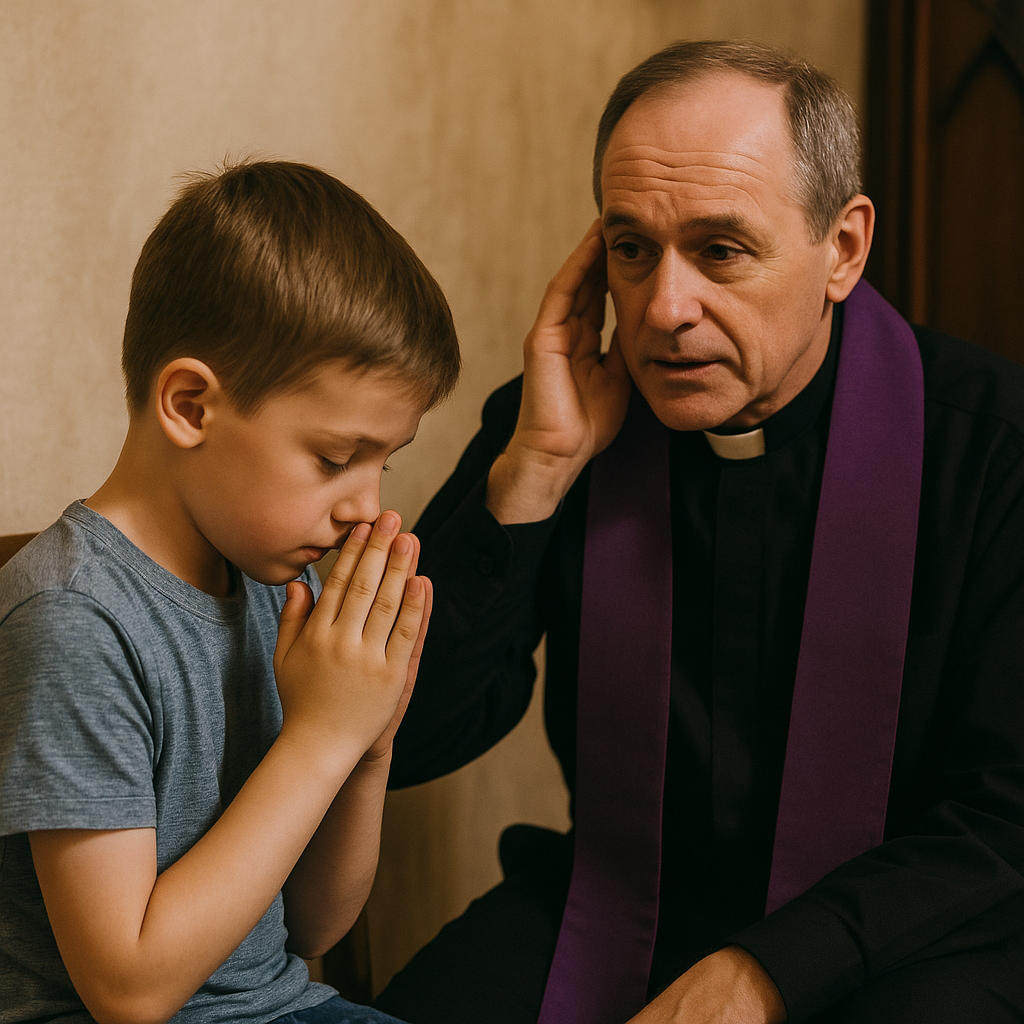
For example, according to Baptist belief, no man can forgive sins — only Jesus Christ can. But that idea was challenged almost immediately when I read John 20:20–23, where Jesus appears to His disciples after the Resurrection:
“Peace be with you. As the Father has sent me, so I send you.”
When He had said this, He breathed on them and said to them,
“Receive the Holy Spirit. If you forgive the sins of any, they are forgiven them; if you retain the sins of any, they are retained.”
That passage stopped me in my tracks. The word breathed didn’t just mean inhaling and exhaling — it was something supernatural. Jesus was doing what God did in Genesis when He breathed life into Adam. Here, He was breathing new spiritual life into His apostles, giving them divine authority — including the authority to forgive sins.
That realization alone challenged much of what I thought I knew about confession and authority.
The Next Thing I Found That Was Obviously Not Baptist Was the Teaching on Baptism
As I continued reading, baptism stood out as something far deeper than I’d ever realized. It wasn’t just a public symbol or a declaration of faith — it was something that actually did something.
Jesus Himself commanded it clearly:
“Go therefore and make disciples of all nations, baptizing them in the name of the Father and of the Son and of the Holy Spirit.”
— Matthew 28:19
Baptism wasn’t optional. It was how disciples were made.
Even Jesus — who had no sin — was baptized.
“Then Jesus came from Galilee to the Jordan to be baptized by John… and behold, the heavens were opened, and He saw the Spirit of God descending like a dove.”
— Matthew 3:13–17
That scene made me pause. If baptism were only symbolic, why would Jesus do it? He was sinless. I realized that He wasn’t being cleansed — He was making the waters of baptism holy for the rest of us.
Then I came to Acts 2:38, where Peter preaches to the crowd at Pentecost:
“Repent and be baptized every one of you in the name of Jesus Christ for the forgiveness of your sins; and you shall receive the gift of the Holy Spirit.”
That verse shattered my old understanding. Peter didn’t say baptism was an outward sign of an inward change. He said it was for the forgiveness of sins — and that through it, we receive the Holy Spirit.
Jesus’ conversation with Nicodemus confirmed it:
“Unless one is born of water and the Spirit, he cannot enter the kingdom of God.”
— John 3:5
For the first time, I understood that “born again” meant born of water and Spirit — not just an emotional moment or a prayer, but a real rebirth through baptism.
Paul’s words in Romans brought it all together:
“We were buried therefore with Him by baptism into death, so that as Christ was raised from the dead… we too might walk in newness of life.”
— Romans 6:3–4
Baptism wasn’t symbolic — it was participation. In baptism, I would die to my old life and rise into new life with Christ.
And then came Acts 22:16, where Ananias says to Saul:
“And now why do you wait? Rise and be baptized, and wash away your sins, calling on His name.”
There it was again — baptism washes away sins.
Peter drives the point home in his first letter:
“Baptism… now saves you — not as a removal of dirt from the body but as an appeal to God for a good conscience, through the resurrection of Jesus Christ.”
— 1 Peter 3:21
Every verse I read said the same thing. Baptism forgives, cleanses, and gives new life. It’s how we’re born again, filled with the Spirit, and joined to the Body of Christ.
The Bible wasn’t pointing toward the theology I had been raised in — it was pointing straight toward the Catholic Church.
.
After understanding confession and baptism, I came to what I now believe is the center of the Christian faith — the Eucharist.
I had always heard growing up that the Lord’s Supper was just a symbol — a reminder of what Jesus did for us. It was meant to stir the heart, not actually do anything. But the more I read Scripture, the more that view stopped making sense.
When I opened John chapter 6, I was shocked by how direct Jesus was:
“Truly, truly, I say to you, unless you eat the flesh of the Son of Man and drink His blood, you have no life in you.
He who eats my flesh and drinks my blood has eternal life, and I will raise him up on the last day.
For my flesh is true food, and my blood is true drink.”
— John 6:53–55
There was nothing symbolic about His words. In fact, many of His followers left Him because of this teaching — and Jesus didn’t call them back to say they misunderstood. He let them go. If it were only a metaphor, He would have clarified. But He didn’t, because He meant exactly what He said.
Then I read what happened at the Last Supper:
“And He took bread, and when He had given thanks He broke it and gave it to them, saying, ‘This is My Body which is given for you; do this in remembrance of Me.’
And likewise the cup after supper, saying, ‘This cup which is poured out for you is the new covenant in My Blood.’”
— Luke 22:19–20
I noticed something I had never seen before — Jesus didn’t say, “This represents My body,” or “This is a symbol of My blood.” He said, “This is My Body… This is My Blood.”
The early Christians believed that too. In 1 Corinthians 10:16, Paul wrote:
“The cup of blessing which we bless, is it not a participation in the blood of Christ? The bread which we break, is it not a participation in the body of Christ?”
Paul didn’t treat Communion as symbolic — he said it was a real participation in Christ Himself. Then, just a chapter later, he warned:
“Whoever eats the bread or drinks the cup of the Lord in an unworthy manner will be guilty of profaning the body and blood of the Lord.”
— 1 Corinthians 11:27
That verse floored me. If it were just a symbol, how could someone be guilty of the body and blood of the Lord? Paul was clearly teaching that Jesus is truly present in the Eucharist.
When I began to see that, everything changed. The Mass was no longer just a service — it was a sacrifice, the same sacrifice of Calvary made present to us in time. The Eucharist wasn’t something we do for God, it was something God gives to us — His very self.
I finally understood why the Church calls it the “source and summit” of the Christian life. In the Eucharist, heaven and earth meet. Christ gives Himself completely, body, blood, soul, and divinity, so that we might be one with Him.
Discovering the Church Fathers
After coming to believe in the Eucharist, I began to wonder — how did the earliest Christians understand all this?
If the first believers after the apostles were truly guided by the Holy Spirit, then their writings should reflect the same faith Christ handed down. I didn’t want to rely only on modern interpretations or denominational traditions. I wanted to hear what those closest to the apostles actually said.
That’s when I discovered the Church Fathers — the bishops, priests, and teachers of the early centuries who preserved and defended the faith long before the Bible was even compiled. Reading their writings felt like opening a time capsule from the first generations of Christianity.
What I found was shocking.
They spoke of the Eucharist as the real Body and Blood of Christ.
They described baptism as the means of being born again and washed of sin.
They talked about bishops and apostolic succession — the direct passing on of authority from the apostles themselves.
And they all recognized the Church as one, visible, and universal — what the word Catholic actually means.
One of the first writings I read was from St. Ignatius of Antioch, a disciple of the Apostle John, writing around 107 A.D. He said:
“Take care to participate in one Eucharist; for there is one flesh of our Lord Jesus Christ, and one cup in the union of His blood.”
(Letter to the Philadelphians, 4)
Ignatius also wrote:
“Wherever the bishop appears, there let the people be; as wherever Jesus Christ is, there is the Catholic Church.”
(Letter to the Smyrnaeans, 8)
That line stopped me cold — the Catholic Church.
He used that word in the year 107. Over 900 years before the Reformation, the Church was already called “Catholic.”
Then I read St. Justin Martyr (around 150 A.D.), describing how the early Christians celebrated the Eucharist:
“We call this food Eucharist, and no one may partake of it except one who believes that the things we teach are true, who has been washed with the washing that is for the remission of sins and for rebirth, and who is living as Christ commanded.”
(First Apology, 66)
That description sounded exactly like the Mass. The structure, the prayers, the reverence — it was all there, right from the beginning.
I realized that the early Church wasn’t Baptist, Reformed, or nondenominational. It was Catholic. The same faith, the same sacraments, the same structure that I saw in Scripture were also alive in the writings of the earliest Christians.
The Church Fathers didn’t invent Catholicism — they inherited it.
For me, reading them was like hearing the echo of Christ’s voice still speaking through time.
Conclusion: Coming Home to the Church
Looking back now, I can see that my conversion wasn’t a sudden moment, but a slow and steady unfolding of truth. Every part of my journey — from that small Baptist church of my childhood, to the philosophy classroom, to the pages of Scripture and the writings of the early Church — was leading me somewhere. It was leading me home.
The more I studied, the more I realized that the faith of the apostles didn’t fade away after the New Testament — it lived on in the Church they built, in the sacraments they celebrated, and in the teachings they handed down. What I saw in the Bible was alive in history, and what I saw in history was still alive in the Catholic Church today.
My conversion wasn’t about rejecting where I came from — it was about finding the fullness of what I had always believed. The Church didn’t erase my past; she completed it. When I walk into a Catholic church now, I see the same Christ I read about in Scripture — the same Christ who forgave sins, who baptized, who fed His people with His own Body and Blood. And I realize that what my heart had been searching for all along wasn’t something new. It was something ancient, constant, and true.

 Gen Z Catholic